


The short answer
To sell a $15,000 AV system online, stop thinking of the website as a till and start thinking of it as the first half of the sale. Most high-end buyers will visit many times, compare dealers, read everything, and often want to hear the system before they commit. The store’s job is to answer every question they have along the way, make it easy to talk to someone or book an audition, and make buying online simple for those who are ready.
The retailers who do this well don’t just sell more online. They sell more in the showroom too, because the customers who walk in have already been convinced by the website.
How high-end AV is actually bought
A typical high-end purchase looks something like this:
- Discovery. A search for a specific model, a review, or a recommendation on a forum.
- Research. Several visits to manufacturer and dealer sites, reading specifications, reviews and buying guides.
- Shortlisting. Comparing two or three dealers on trust, service, availability and what they offer beyond the box.
- Audition or conversation. A visit to a listening room, a call, or a chat with a specialist.
- Decision. Online, in the showroom, or by phone, often with finance and installation.
- Ownership. Setup, support and, if it goes well, the next upgrade.
A store built only for step five misses most of the journey. A store built for all six wins buyers who would otherwise finish with someone else.
The product page: built for a five-figure decision
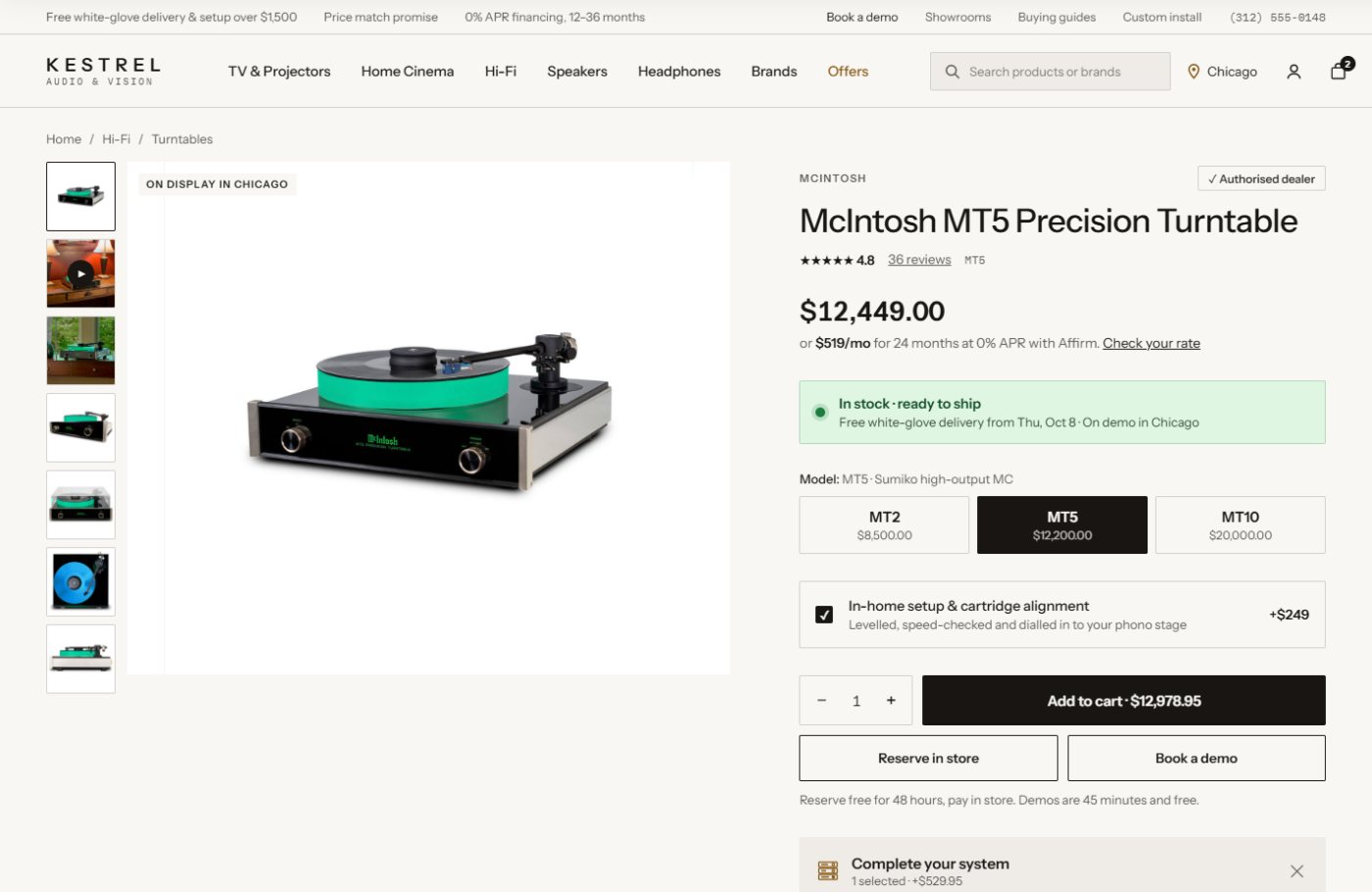
The product page is where a high-ticket sale is won or lost. Everything on it should answer a question the buyer is asking:
- What does it cost, and monthly? Price with finance terms beside it.
- Is it here? Stock, and whether it’s on display in the showroom.
- Can I hear it? A demo booking right on the page.
- Is this the right one? Structured specifications that can be compared, not a wall of manufacturer text.
- Can I trust this dealer? Authorised-dealer status, warranty and reviews.
- Will it be set up properly? Installation, calibration or setup options.
- What else do I need? A system builder suggesting matched components.
- Can I see it properly? Large images, detail shots, video and the finish options.
None of these come with a standard theme. Each is a design and data decision, which is why high-ticket retailers get so much more from a custom build. Our guide to custom Shopify theme vs template explains the trade-off.
Finance
Showing a monthly figure beside a five-figure price is one of the most effective changes a high-end store can make. “$12,449” reads as a big decision; “from $519 a month” reads as a manageable one. Buy-now-pay-later and consumer finance providers integrate with Shopify, and the messaging can appear on product pages, in the basket and at checkout.
Make the finance offer specific and accurate, show it consistently, and make sure it’s permitted under your manufacturers’ advertising policies.
Want to see where finance would sit on your product pages?
Book a free auditPresenting price under MAP
Under minimum advertised pricing, the number on the page is usually the same as every other authorised dealer’s. How it’s presented still matters:
- Lead with value, not the number alone. What’s included, from delivery and setup to warranty and support.
- Show finance alongside, so the monthly figure frames the decision.
- Bundle thoughtfully, where your manufacturers allow it, so a system price reflects matched components.
- Make services visible, such as installation, calibration or trade-in, which add value without breaking MAP.
- Keep prices accurate everywhere, on the site, in the showroom and on Google Shopping.
Our guide to minimum advertised price covers the policy side in more detail.
Trust
At this price, buyers worry about grey-market stock, warranty, delivery damage and whether anyone will help if something goes wrong. Answer those worries before they’re raised:
- Authorised dealer status, stated clearly on product pages for the brands you represent.
- Your showroom and team, with real photos, names and addresses.
- Reviews, of products and of your store.
- Warranty and returns, explained plainly, not buried in terms.
- Delivery and installation, including how fragile, heavy items are handled.
- Secure, familiar payment options, including finance.
Bringing the showroom online
Your listening room is your biggest advantage over online-only competitors. The website should lead people to it:
- Mark products that are on display and available to audition.
- Let buyers book a demo for a specific product or system.
- Show stock per location if you have more than one showroom.
- Offer reserve online, collect or audition in store.
- Feature the rooms themselves: what’s set up, and what it’s like to visit.
Showroom stock can also appear in Google search through local inventory ads and free local listings. Our local inventory ads guide covers how.
Selling systems, not boxes
High-end buyers often need a system, not a single product: a turntable with a phono stage, cartridge and interconnects; speakers with an amplifier and cables; a projector with a screen and processor. Selling those well online means:
- System builders on the product page, suggesting matched components with a combined price.
- Curated systems at different price points, built by your specialists.
- Room-based guidance: what works in a small lounge versus a dedicated cinema room.
- Upgrade paths, showing what to add next.
It raises order values, and it shows the expertise that distinguishes a specialist from a box-shifter.
A system builder works best when it’s honest. Recommend components because they suit each other and the room, not because they carry the best margin, and explain why. Buyers spending this much can tell the difference, and the trust it builds is worth more than any single add-on.
Expertise as content
Every authorised dealer can publish the same manufacturer description. What only you can publish is your specialists’ knowledge: which amplifier suits which speakers, how to set up a room, what changed between this model and the last, and honest comparisons. That content wins search traffic other dealers can’t, and it builds the trust that closes a high-ticket sale.
Write product descriptions that go beyond manufacturer copy, and support them with buying guides and system recommendations. Our guide to why manufacturer copy stops your product pages ranking covers this in more detail.
Making it easy to talk
Many high-end sales close in a conversation. The store should make that conversation easy to start:
- A phone number visible on every product page, not just the contact page.
- Live chat answered by someone who knows the products.
- A callback or “ask a specialist” option on high-ticket products.
- Opening hours and response times stated honestly.
Track these conversations where you can, because they’re often where an online visit becomes a sale. Even a simple note of which product page a caller was looking at, or a dedicated number on the website, shows how much offline revenue the store is starting.
The checkout
For buyers ready to purchase online, the checkout should be fast and familiar. Shopify’s checkout supports accelerated payment options and finance, and handles deposits and partial payments where a system is ordered in or installed later. Delivery and installation choices should be clear before payment, not discovered afterwards.
Speed matters throughout. Shopify’s own data puts the cost of every extra 100ms of load time at roughly 3.5% of conversion, and on five-figure orders small changes are large sums.
After the sale
The relationship with a high-end buyer doesn’t end at delivery. Setup, follow-up and support decide whether they come back for the next upgrade and recommend you to others. Post-purchase emails with setup advice, a check-in after installation, and invitations to new-model auditions all keep a valuable customer close.
Photography and video
A buyer can’t hold a $15,000 amplifier online, so the images have to do the work. The best high-end stores combine:
- Large, sharp product images that can be zoomed to see finishes, controls and build quality.
- Every finish shown accurately, because a walnut veneer and a gloss black are different purchases.
- Connection panels, because buyers want to know what plugs in where.
- Room shots that show scale and how the product looks in a real space.
- Short video: a walk-round, a demonstration or a specialist explaining what makes it special.
Manufacturer imagery is a good starting point. Your own photography and video, ideally in your listening rooms, is what makes the listing yours.
Designing for mobile research
Much of the research for high-end AV happens on a phone, often in the evening, often more than once. The mobile product page needs to carry everything the desktop one does, in an order that works on a small screen: price and finance first, then availability and demo booking, then specifications in a form that’s easy to scan. Fast loading on a mobile connection matters more here than anywhere else, because a slow page on the sofa is a page that gets closed.
Common mistakes
Hiding the price. “Call for price” sends researchers to the dealers who show it.
Manufacturer copy only. It gives Google and buyers no reason to choose your page.
No route to the showroom. The website and the listening room are treated as separate businesses.
A phone number on the contact page only. The moment a buyer wants to talk is on the product page.
Judging marketing on online checkouts alone. It undervalues the website and leads to budget cuts in the wrong places.
A generic template. Premium brands presented like a clearance sale undermine the price.
Marketing a long decision
Marketing for high-ticket AV has to respect the buying cycle:
- Google Shopping and search to appear for the exact models buyers research. Our Google Shopping with Shopify guide covers this.
- Remarketing to stay visible during weeks of research.
- Email for new arrivals, auditions and events.
- Seasonal planning around Black Friday and Christmas, when demand peaks.
- Patience in judging results, because a click today may be a sale next month.
Measuring sales that close offline
If you only count online checkouts, your website and marketing will look far less effective than they are. Many buyers research online and buy in the showroom or by phone, and ad platforms rarely see those sales.
We measure against total store revenue instead: a blended return across all channels, set against total marketing spend. Our guide to showroom sales attribution covers how to connect online activity to offline sales.
What it returns
Hi-Fi Centre, a high-end audio, video and hi-fi retailer in Vancouver, is a showroom-led business that lockdown forced to sell online. After a technical rebuild of its Shopify store, ecommerce conversion rate rose 132%, and revenue has tripled in three years, at a 19x blended return on ad spend measured against real store revenue.
Lipton’s Audio & Video saw conversion rate rise 420% following its rebuild, then revenue growth of +191% and +114% in successive years. Both full accounts are in the Hi-Fi Centre and Lipton’s case studies.
High-ticket store checklist
- Finance shown beside the price on high-ticket products.
- Stock and showroom availability on every product page.
- Demo booking from the product page.
- Structured, comparable specifications.
- Authorised-dealer status, warranty and returns stated clearly.
- Installation and setup options where you offer them.
- System builders and curated systems.
- Phone, chat and callback visible on product pages.
- Fast pages, measured on real visitors.
- Original buying guides and product content.
- Measurement against total store revenue.
Get your store audited against this list.
Book a free auditSelling high-end AV online: FAQ
Sources
Results are from the Lipton’s and Hi-Fi Centre case studies. The 100ms load-time figure is Shopify’s own data across live stores, as cited on our homepage. Product page examples are from our demo hi-fi store.