


The short answer
Buyers research with specialists because specialists know more. They buy elsewhere when the moment of purchase feels easier or safer with someone else. Under minimum advertised pricing, the price is usually the same, so it comes down to confidence and convenience: is it in stock, when will it arrive, can I pay monthly, can I return it, do I trust this store?
Every one of those questions can be answered on your product page. Most specialist stores don’t answer them clearly, and that’s where the sale leaks away.
The pattern
It usually looks like this. A buyer finds your guide to choosing a streaming amplifier. They read your product pages for three models, call with a question, perhaps visit to listen. They thank your team, go home, and two days later order the same model from a national retailer.
It happens in other ways too. A buyer reads three of your buying guides, compares your product pages with two other dealers, and orders from the one that showed a delivery date. Or a couple audition a system on Saturday, go home to think, and buy it on Sunday night from the only retailer whose site let them pay monthly.
Your expertise created the demand. Someone else captured it. The frustration is understandable, but the cause is rarely disloyalty. It’s friction: something about buying from you felt harder, slower or riskier at the moment the decision was made.
Why buyers leave
| Reason | What the buyer is thinking | Fix on your store |
|---|---|---|
| Stock uncertainty | “Do they actually have it?” | Show stock and showroom availability |
| Delivery doubt | “When would it arrive?” | State delivery dates and options |
| No finance | “I’d rather pay monthly.” | Show finance beside the price |
| Returns worry | “What if it’s not right?” | Explain returns plainly |
| Checkout friction | “This feels clunky.” | Fast, familiar checkout |
| Trust gap | “I know the big store.” | Reviews, dealer status, real people |
| Slow site | “This is taking ages.” | Engineered speed, fewer apps |
| Out of hours | “I’ll just order now elsewhere.” | Let them buy or reserve online any time |
It isn’t price
Many specialist retailers assume they lose sales on price. For authorised products under MAP, the advertised price is usually the same everywhere. What differs is everything around the price: what’s included, how easy it is to pay, how quickly it arrives, and how confident the buyer feels.
That’s good news. Price is the one thing a specialist can’t easily change. Everything else is within your control, and most of it lives on the product page. Our guide to minimum advertised price covers how to compete when price is fixed.
Confidence
A buyer spending thousands needs to feel safe. Large retailers win on familiarity: the buyer has bought from them before and knows what happens if something goes wrong. A specialist has to make that safety visible:
- Authorised-dealer status for each brand, stated on the product page.
- Reviews of your store and service, shown where buyers decide, not hidden on a separate page.
- Warranty and returns explained in plain language.
- Real people: your team, your showroom, your address and phone number.
- A professional store that looks as premium as the brands it sells.
Convenience
Convenience is often the deciding factor late at night, when the showroom is closed and the buyer is ready. If your website makes buying slow or uncertain, a national retailer one tab away wins by default. Make the online path as easy as theirs: clear stock, clear delivery, finance, a fast checkout, and the option to reserve for a showroom visit.
Want to see your store through a buyer’s eyes?
Book a free auditWhat large retailers do well
It’s worth being honest about why national retailers win the order. They’ve spent years removing friction from buying:
- Certainty. Every product page states stock, delivery date and returns in the first screen.
- Familiarity. Buyers have an account, saved payment details and a history of orders that arrived.
- Reviews everywhere. Thousands of them, on every product.
- Payment choice. Cards, wallets and instalments, all in a familiar checkout.
- Speed. Pages and checkout that load quickly on a phone.
None of this needs their scale. A specialist store can match every point, and then add what they can’t: auditions, expertise, installation and a relationship.
The out-of-hours buyer
A large share of AV research happens in the evening and at weekends, when the showroom is closed and nobody answers the phone. That’s exactly when a buyer who has decided is most likely to order from whoever makes it easiest.
Give that buyer a way to commit with you: buy online, reserve for collection or audition, book a demo for the next morning, or request a callback at a set time. Even a clear statement of when you’ll respond keeps more buyers than silence.
Services that tip the balance
Under MAP, services are how a specialist adds value without touching the price. The ones that most often keep a sale:
- Delivery and installation, including setup, cabling and calibration.
- Room advice, such as speaker placement or acoustic suggestions.
- Trade-in of the buyer’s existing equipment.
- Extended support, a named contact and help after the sale.
- Home demonstrations for larger systems, where practical.
The key is making these visible on the product page, not just mentioning them in conversation. A buyer comparing two tabs at midnight only sees what’s written down.
Product pages that keep the sale
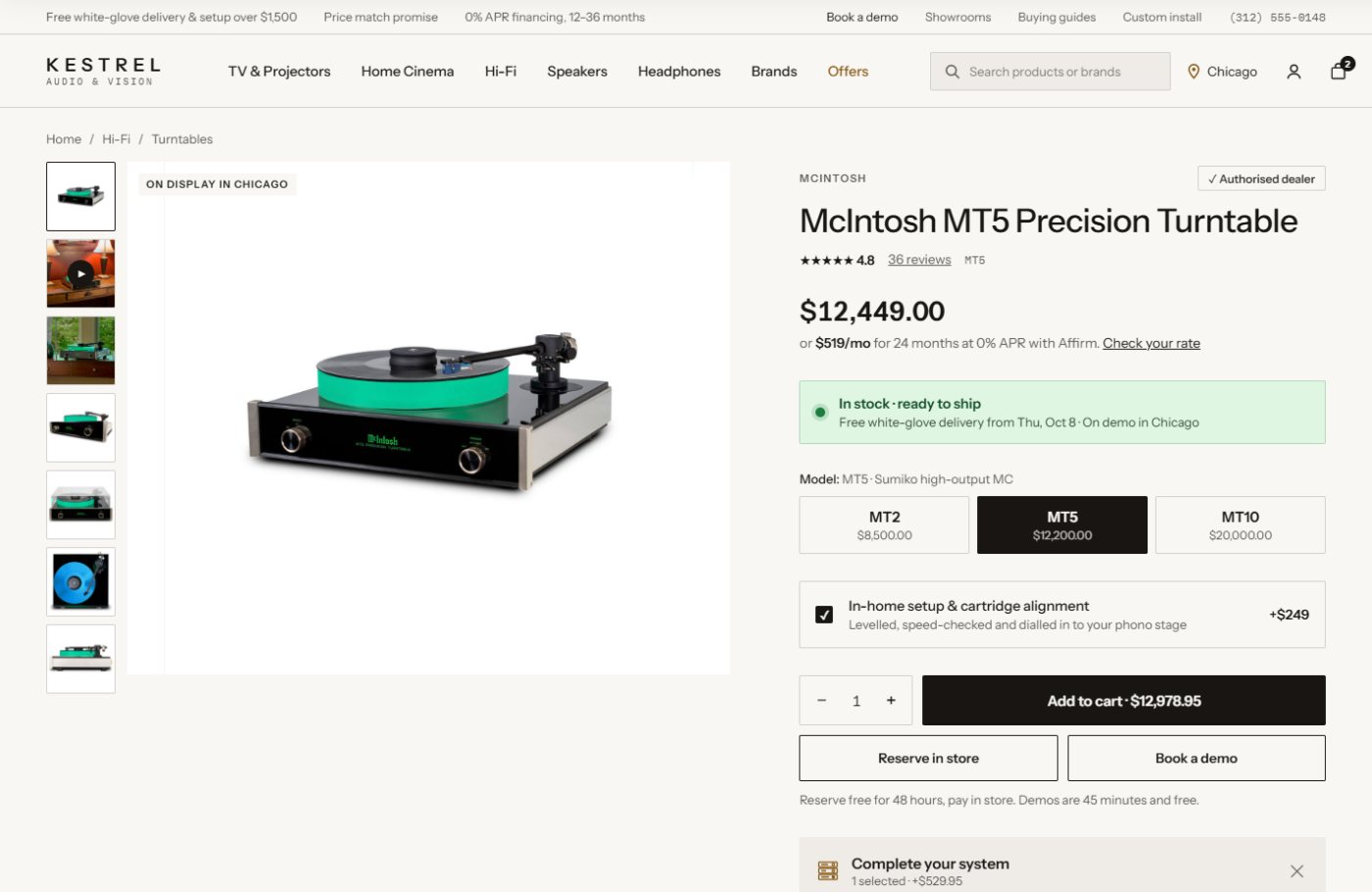
The product page is where research turns into a decision, and where most specialist stores lose it. A page that keeps the sale answers, in order of importance:
- The price, and what it costs monthly.
- Whether it’s in stock, on display, and when it can arrive.
- Why buy it from you: setup, support, warranty, expertise.
- How to hear it, ask about it or reserve it.
- The specifications, structured and comparable.
- What else the system needs.
Our guide to selling a $15,000 AV system online goes through each element in detail.
Stock and delivery
“Contact us for availability” is one of the most expensive phrases on a specialist website. It sends a buyer to a store that simply says “in stock, delivered Thursday”. Show stock levels or status on every product, show what’s on display in the showroom, and give realistic delivery dates, including white-glove delivery or installation where you offer it. If an item is ordered in, say how long it takes.
Finance and checkout
If a national retailer offers instalments and you don’t, you’ve given buyers a practical reason to leave. Show finance beside the price on high-ticket products. Then make the checkout fast and familiar, with accelerated payment options and clear delivery choices before payment. Shopify’s checkout handles both well, and speed matters at every step: Shopify’s data puts the cost of every extra 100ms of load at roughly 3.5% of conversion.
The mobile moment
Much of this decision happens on a phone, often the same evening as an audition. On mobile, every point of friction is magnified: a slow page, a hidden phone number, a stock status buried below the fold, a checkout that asks for too much. Test your own product pages on a phone over a mobile connection, as a buyer would, and fix what you find. It’s often the quickest way to see why researched buyers finish elsewhere.
Trust signals
- Store reviews and product reviews, with replies.
- Years trading and the brands you’re authorised for.
- Photos of your listening rooms and team.
- A phone number on every product page.
- Clear policies: delivery, returns, warranty, privacy.
- Secure, familiar payment badges and finance providers.
None of these cost much. All of them reduce the reasons to go elsewhere. Put them where the decision is made, on the product page and in the basket, rather than collecting them on an “about us” page few buyers visit.
Using the showroom
Your showroom is the one thing a national online retailer can’t offer. Use it to close sales, not just to host auditions:
- Let buyers reserve a product online and audition before paying.
- Offer to hold an item for a few days after an audition.
- Make it easy to buy in the showroom on finance, there and then.
- Show what’s on display on the website and in Google search, through local inventory. Our local inventory ads guide covers how.
Aligning the team
The website and the showroom often work as separate businesses, with separate targets. Buyers don’t see it that way. When showroom staff can see what a customer browsed online, quote the same delivery promise as the website, and complete a sale on the same system, buyers feel one consistent retailer rather than two.
Small changes help: give staff access to online stock and product pages on a tablet in the listening room, agree the same delivery and finance messages everywhere, and credit the website when a showroom sale started online. When the team sees the website as part of how they sell, they use it to close sales rather than compete with it.
Following up
Many buyers who audition and leave aren’t lost; they’re undecided. A prompt, helpful follow-up often settles it: a note summarising what they heard, availability, the finance figure, what’s included, and a simple way to complete the purchase online or by phone. Done with care rather than pressure, it’s one of the cheapest ways to keep a sale.
Online, the equivalent is remarketing and email for buyers who viewed high-ticket products. They work best once the store itself has removed the reasons people left.
Content only you can write
A national retailer publishes the manufacturer’s description. You can publish your specialists’ judgement: which amplifier suits which speakers, how a model sounds in a real room, what changed from the last version, and honest advice about whether it’s right for the buyer. That content brings in search traffic other dealers can’t, and it builds the trust that makes buyers want to buy from the people who helped them.
Our guide to why manufacturer copy stops your product pages ranking covers this in detail.
Seeing the problem
Signs that your store is creating demand that others capture:
- Product pages with strong traffic and time on page, but low conversion.
- Buyers mentioning other retailers’ offers in calls or in the showroom.
- Auditions that don’t turn into sales.
- Brand or model searches that bring people to your guides, but not to your product pages.
Measuring against total store revenue, rather than online checkouts alone, shows how much demand your site is creating, and how much more it could keep. Our guide to showroom sales attribution explains how.
Fixes, in order
- Phone number and chat on every product page. Quick to do, immediate effect.
- Stock, showroom availability and delivery dates shown clearly.
- Finance beside the price on high-ticket products.
- Reviews and dealer status on product pages.
- Reserve online, audition in store.
- Follow-up for auditions and high-intent visitors.
- Product page redesign with structured specifications and original content.
- Speed, engineered rather than patched.
Work through them in this order because the early fixes are cheap and fast, and they show quickly whether friction was the problem. If conversion moves after the first few, you’ll know the deeper work is worth it.
The first six can often be done on your current store. The last two usually come with a rebuild. Our custom Shopify theme vs template guide helps decide when.
Get these prioritised for your store.
Book a free auditWhat changes
Hi-Fi Centre is a showroom-led high-end retailer in Vancouver. After its store was rebuilt, ecommerce conversion rate rose 132% and revenue tripled in three years. Lipton’s Audio & Video saw conversion rate rise 420% following its rebuild. Both still sell through their showrooms; their websites now keep far more of the demand their expertise creates. The full accounts are in the Hi-Fi Centre and Lipton’s case studies, and our approach is on Shopify website design for hi-fi and AV retailers.
Research with you, buy elsewhere: FAQ
Sources
Results are from the Lipton’s and Hi-Fi Centre case studies. The 100ms load-time figure is Shopify’s own data across live stores, as cited on our homepage.