


The short answer
If you’re launching a new store or testing a range, use a template. It’s fast, cheap and good enough to prove demand.
If you’re an established hi-fi or home cinema retailer with a deep catalogue, high average order values and a showroom that closes big sales, a template will start costing you more than it saves. The gaps get filled with apps, the store slows down, and it looks like every other dealer selling the same brands at the same price. That’s when a custom Shopify theme pays for itself.
What a Shopify template is
A template, or theme, is a pre-built storefront design. Shopify includes free themes with every store, and the Shopify Theme Store sells premium themes for a one-off licence, usually a few hundred dollars.
Modern themes are built from sections and blocks, so you can rearrange the homepage, swap images and change colours and fonts without writing code. That’s their great strength: a non-technical owner can have a professional-looking store live in days.
The limitation is built into the same idea. A template is designed to suit thousands of stores across every category, so its layouts, product pages and filtering are general-purpose. You configure it; you don’t design it around your customers.
What a custom Shopify theme is
A custom theme is designed from a structured brief around your brand, your range and how your customers actually buy, then built as native Shopify theme code that belongs to you.
It still uses Shopify’s sections and blocks, so your team can edit content and build pages without a developer. The difference is that every template, from the homepage to the product page, is designed for your store rather than adapted from someone else’s. Features that a template would need apps for, like specification filtering, comparison, bundles or showroom stock, are built into the theme itself.
Your catalogue, customers, orders and apps stay exactly where they are on Shopify. Only the store around them changes.
Custom theme vs template, side by side
| Template | Custom theme | |
|---|---|---|
| Upfront cost | Free, or a licence of a few hundred dollars, plus setup time | From $9,997 with KA Consultancy |
| Time to launch | Days | Typically 2–6 weeks |
| Design | Configured within the template’s layouts | Designed around your brand and customers |
| Product pages | General-purpose | Built for your specifications and buying questions |
| Filtering | Basic, or extended with apps | Built around how your customers shop |
| Speed | Depends on the theme and every app added | Engineered in; fewer apps needed |
| Technical SEO | Theme defaults | Controlled across every template |
| Updates | Theme updates can overwrite customisations | Your own code; nothing overwritten |
| Ownership | Licensed | Owned outright |
| Best for | New stores, small ranges, testing demand | Established stores with real traffic and a brand to protect |
Where templates fall short for high-end AV
Templates work well for a lot of stores. High-end AV asks things of a store that general-purpose themes weren’t designed for.
Specification-heavy catalogues
Amplifiers, speakers, turntables and projectors are bought on specifications: power, impedance, sensitivity, connections, finishes. A template’s product page is designed for a description and a few images. Fitting structured specifications into it usually means a long text block or an app.
Filtering that matches how buyers shop
An AV buyer narrows a range by brand, room, budget, drive type or connection. Template filtering is generic, and extending it with apps often creates thin duplicate pages that waste crawl budget and slow collection pages down.
High-ticket product pages
A $12,000 purchase raises questions a $40 purchase doesn’t: monthly finance, whether it’s on display to hear, authorised-dealer status, in-home setup and what else the system needs. Templates don’t have places for those answers, so they end up missing or bolted on.
The showroom
Most premium AV sales still close in a listening room or on the phone. A store that can show in-store stock, book a demo and route enquiries supports those sales. A template treats the website as the whole shop.
Looking like every other dealer
Under minimum advertised pricing, every authorised dealer shows the same price for the same model. If your store also looks like theirs, a buyer has no reason to choose you over a national retailer. Presentation, expertise and trust are the only levers left, and a template limits all three.
Wondering whether your current theme is holding you back?
Book a free auditWhen a template is the right call
There are plenty of situations where a custom theme would be the wrong spend:
- You’re launching or testing. Until you know the range sells, keep the money for stock and marketing.
- Your catalogue is small and simple. A few dozen products without deep specifications fit a template comfortably.
- You need to be live this week. A template can be; a properly designed custom theme can’t.
- The budget would stretch you. If a $9,997 build would take most of your available capital, a template is the sensible start.
- Your problem isn’t the store. If traffic is low or the range isn’t right, a new theme won’t fix it.
Starting on a template and moving to a custom theme once the store has earned it is a perfectly good plan.
The middle route: a customised template
Many stores end up somewhere in between: a purchased theme with code changes made by a freelancer or agency. It can be a sensible step, but it comes with three costs worth knowing about.
- Updates become risky. The more the theme’s code is changed, the harder it is to accept the original developer’s updates without breaking something.
- Changes pile up. Each small fix adds code on top of a theme that wasn’t designed for it, and speed tends to drift down over time.
- The work doesn’t carry over. When the store eventually moves to a custom theme, most customisations are rebuilt from scratch, so you pay for them twice.
If you’re already on a heavily customised template, that’s often the clearest sign it’s time for a custom theme.
Speed, apps and the hidden cost of templates
Shopify’s own data across live stores puts the cost of every extra 100ms of load time at roughly 3.5% of conversion. On a store where the average order is in the thousands, that’s a meaningful number.
Templates aren’t slow in themselves. The slowdown comes from what’s added to them. Every gap in a template tends to become an app: filtering, bundles, comparison, product options, finance messaging, page building. Each app carries a monthly fee, and most add their own scripts to every page.
A custom theme approaches it the other way round. Features the store needs are built into the theme, so they load as part of it, and the app list stays short. Speed targets are set at the start, typically 1.5–2 seconds to load, with INP under 200ms and CLS under 0.1, and measured on real visitors after launch.
See how fast your store is, and what’s slowing it down.
Book a free auditIf you choose a template: what to look for
If a template is the right call for now, choose it with the next stage in mind. A few checks make a big difference later:
- Speed out of the box. Test the theme’s demo store on a phone over a mobile connection, not on office wifi.
- Product page flexibility. Look for room to add specification tables, tabs, video and related products without an app.
- Filtering. Check how it handles large collections and whether filtered pages create their own URLs.
- Active development. A theme that’s updated regularly keeps pace with Shopify’s own features.
- Restraint with apps. Install apps only for features the theme genuinely can’t provide, and remove ones you stop using.
- Clean product data from day one. Structured specifications and consistent images make the eventual move to a custom theme far cheaper.
What changes for your team day to day
Owners often worry that a custom theme means calling a developer for every change. It shouldn’t.
A properly built custom theme uses Shopify’s own editor, so your team adds products, edits pages, swaps banners and builds landing pages the same way they would on a template. The difference is that the sections they’re working with were designed for your store: a brand page block, a listening-room feature, a specification table, a system builder.
Where things do change is in what you stop doing. No juggling apps that conflict with each other. No workarounds when a template won’t show what you need. No worrying that a theme update will undo last month’s changes. New templates, such as a page for a new brand, are scoped as and when you need them, on code you own.
What a custom theme looks like for an AV store
These screens are from our demo hi-fi store, built to show how a premium AV retailer should present itself online.
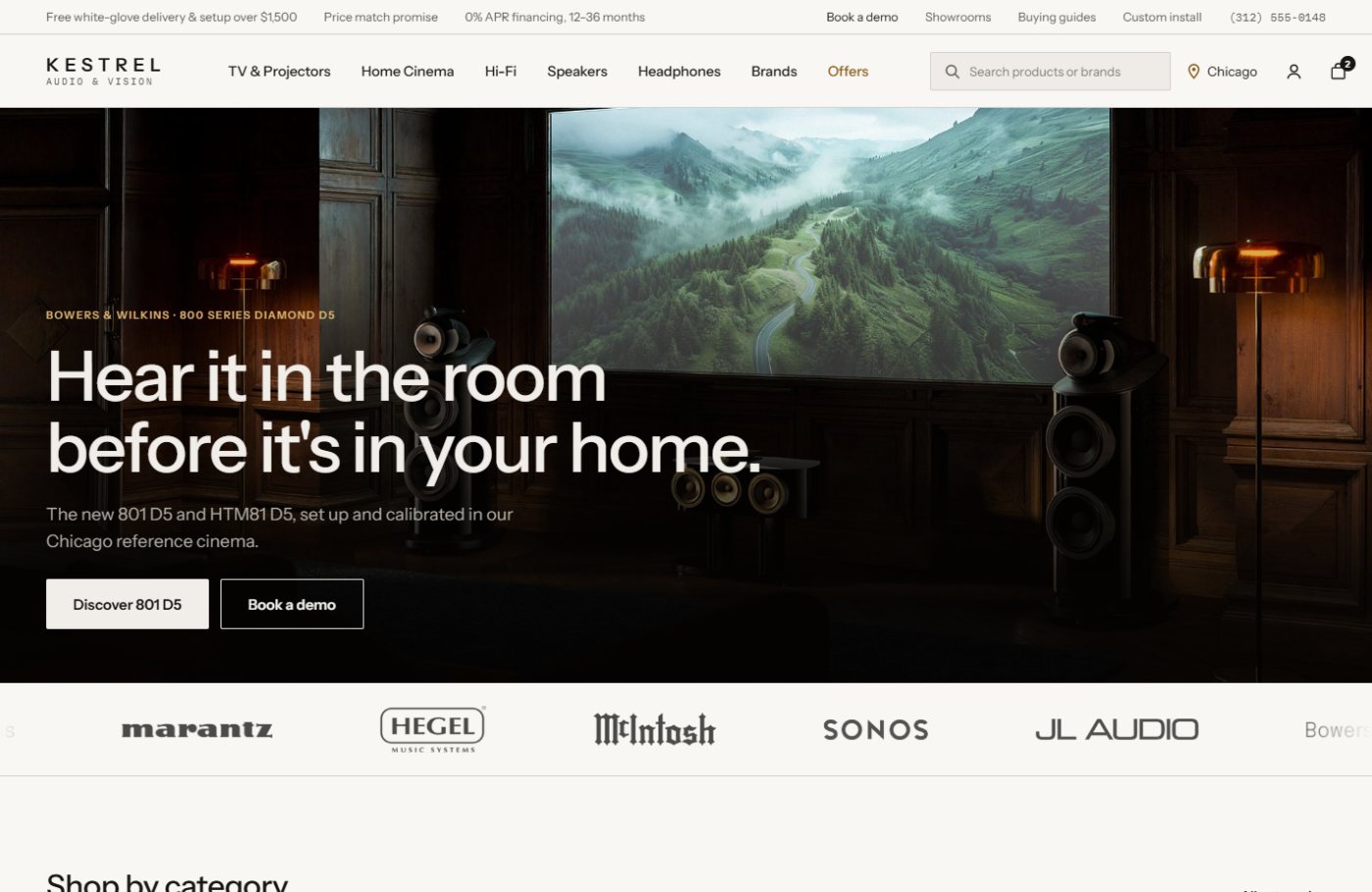
The homepage leads with a flagship system and a demo booking, then hands over to category and brand navigation, so a buyer goes straight to what they came for. Nothing on it is a generic template block.
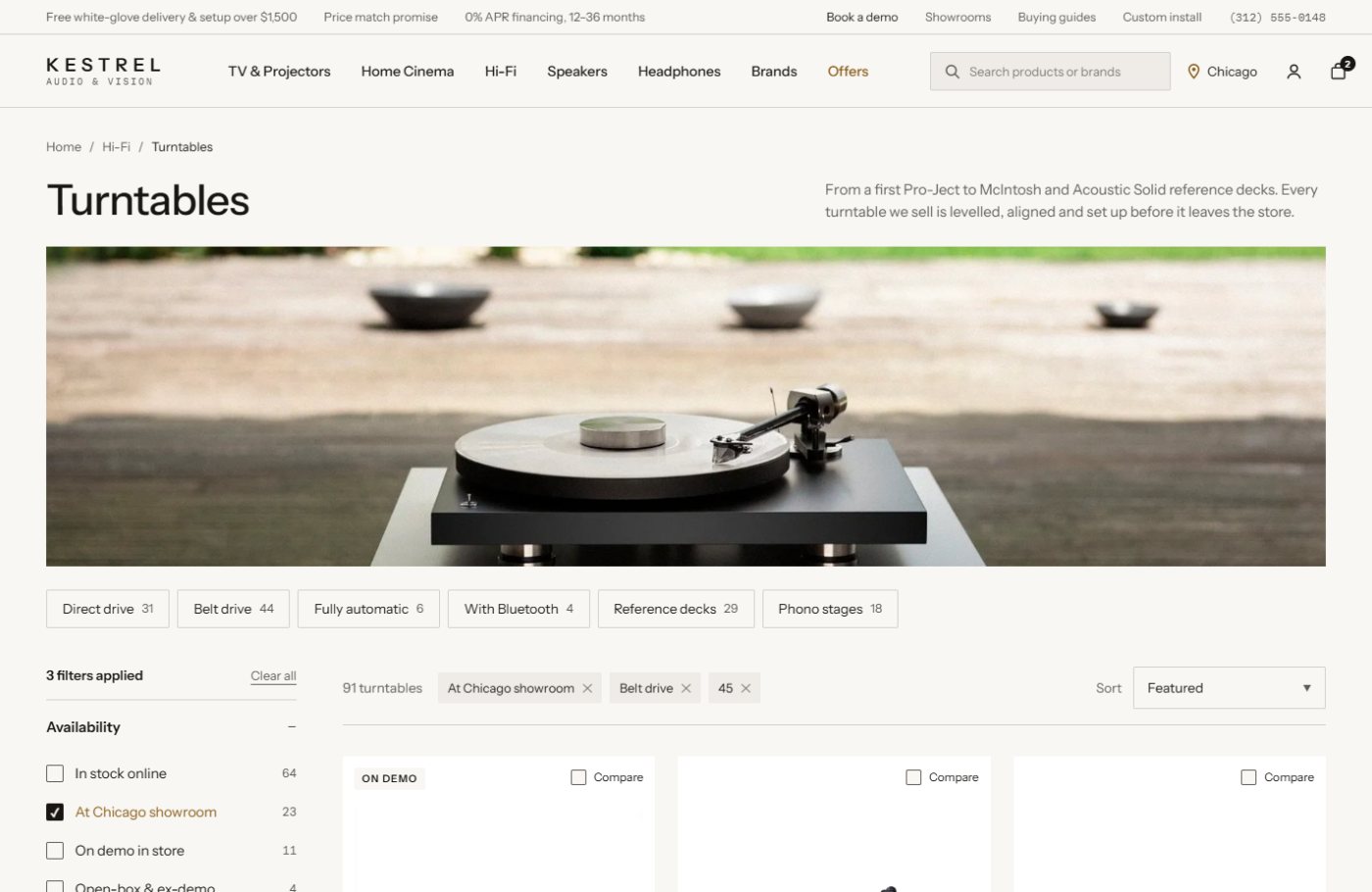
The collection page filters by drive type, brand, price and what’s on display in the showroom. Each card shows what matters before the click. That filtering is part of the theme, not an app, so it’s fast and doesn’t create thin duplicate pages.
Four myths about custom themes
“A custom theme locks me into one agency.”
Only if the agency keeps the code. With KA Consultancy you own the theme outright, with documentation, so any competent Shopify developer can work on it later.
“I’ll lose my products and customers.”
On Shopify, the theme sits on top of your data. Products, customers, orders and apps stay where they are; only the storefront around them changes, and it’s built in preview first.
“Custom means slow and fragile.”
Badly built custom themes can be both. A well-built one is usually faster than a template with apps added, because it carries only the code the store needs and has speed targets set from the start.
“Templates are always cheaper.”
Upfront, yes. Over three years, once app subscriptions, customisation work, lost conversion and the eventual rebuild are counted, an established AV store often pays more on the template route.
The cost over three years
Comparing a template’s licence with a custom build’s fee misses most of the picture. Over three years, these are the lines that differ:
| Cost | Template route | Custom theme route |
|---|---|---|
| Upfront | Licence plus setup time | From $9,997 |
| Apps to fill gaps | Higher: more features rented monthly | Lower: features built into the theme |
| Customisation work | Ongoing, and at risk from updates | Scoped as needed, on your own code |
| Speed and conversion | Tends to drift down as apps are added | Engineered and monitored |
| Eventual rebuild | Likely once the store outgrows it | Already done |
For a small store, the template route is usually cheaper even over three years. For an established AV retailer, the app line, the lost conversion and the eventual rebuild usually tip it the other way. Our Shopify website cost guide for AV retailers sets out a full year-one budget.
A custom theme in practice
Hi-Fi Centre is a high-end audio, video and hi-fi retailer in Vancouver, trading since 1984. It was already on Shopify, so there was no migration: we built a custom theme on the existing store, with technical SEO built in, and grew it organically before any paid media was switched on.
Page load fell from 3.2 seconds to under one second. In the first seven months, before a single dollar went into advertising, ecommerce conversion rate rose 132% and organic revenue rose 488%. Revenue has since tripled in three years.
The full account is in the Hi-Fi Centre Shopify case study, and you can see how we approach Shopify website design for hi-fi and AV retailers.
How to decide
Run through these questions honestly. The more you answer “yes”, the stronger the case for a custom theme.
- Is your store already trading steadily, with real traffic to convert?
- Do you carry more than a few hundred products, or products bought on specifications?
- Is your average order value in the hundreds or thousands?
- Do you run more than a handful of apps to fill gaps in your theme?
- Has your store been customised so much that updates feel risky?
- Do sales regularly close in a showroom or on the phone after online research?
- Does your store look much like your competitors’?
Three or more yeses usually means a custom theme will pay for itself. Fewer, and a well-chosen template, or a redesign on what you have, may be the better spend.
Get a straight answer for your store.
Book a free auditCustom Shopify theme vs template: FAQ
Sources
KA Consultancy prices, inclusions and timelines are as published on our Shopify website design page. Hi-Fi Centre results are from the Hi-Fi Centre case study. The 100ms load-time figure is Shopify’s own data across live stores, as cited on our homepage. Theme Store pricing changes; check themes.shopify.com for current licences.