


The short answer
Most Shopify cost guides are written for T-shirt brands. A store selling $20,000 systems from thirty specialist brands is a different job: deeper specifications, authorised-dealer rules, a showroom that closes the big sales, and customers who research for weeks before they buy.
We’ve built and optimised more than 350 Shopify stores over twenty years, including two premium AV retailers in Canada that are still growing years after their rebuilds. This is what a build like that costs, broken down so you can budget it before you speak to anyone.
The three parts of a Shopify website cost
What you pay for a Shopify website splits into three parts, and most quotes only show you one of them.
- The build. Design, development, migration and setup. A one-off fee.
- The platform. Shopify’s monthly plan, plus payment processing on every sale.
- The running costs. Apps, your theme’s upkeep, and the marketing that brings people to it.
The build gets the attention because it’s the biggest single invoice. For an AV store, the running costs are where a cheap build gets expensive: every gap in the theme becomes an app subscription, and every app adds code that slows the store down.
Shopify plan costs in 2026
Shopify’s plans are the fixed part. These are the published US prices; paying annually takes roughly 25% off.
| Plan | Billed monthly | Billed annually (per month) | Per year, paid upfront | US online card rate | Extra fee with another payment provider |
|---|---|---|---|---|---|
| Basic | $39 | $29 | $348 | 2.9% + 30¢ | 2% |
| Grow | $105 | $79 | $948 | 2.7% + 30¢ | 1% |
| Advanced | $399 | $299 | $3,588 | 2.5% + 30¢ | 0.6% |
| Plus | From $2,300 | Contract | Contract | Negotiated | 0.2% |
For most established AV retailers, Grow or Advanced is the right plan. Advanced earns its place once card volume is high enough that the lower rate covers the higher fee. Plus is for multi-market, wholesale or very high volume, and most showroom retailers don’t need it.
The payment cost AV stores forget
On a $15,000 system, the difference between card rates is real money. At 2.9% that sale costs about $435 in processing; at 2.5% it’s about $375. If a large share of your sales are high-ticket, model this before choosing a plan, and before choosing a payment provider, because Shopify adds its own fee on top of any provider that isn’t Shopify Payments.
Not sure which plan or build route your store needs? The free audit covers it.
Book a free auditThree ways to build it, and what each costs
There are three realistic routes for an AV retailer. Each has a place; only one suits most established showrooms.
Theme from the store
Licence + your timeFine for a new store proving demand. Your site sits on the same skeleton as your competitors’, and theme updates can overwrite customisations.
Custom theme build
From $9,997A custom-designed, custom-built theme on a clean native codebase. Your catalogue, apps and trading history stay; the store around them is rebuilt. Typically 2–6 weeks.
Bespoke build
From $19,997Plus builds, very large catalogues, custom apps, ERP and finance integrations, B2B and multi-market. Typically 4–8 weeks, invoiced in three stages.
Most AV retailers need the second route. You’ll be told plainly on the audit call if yours needs the third. If you’re weighing a theme against a custom build in more detail, our guide to custom Shopify theme vs template covers the trade-offs.
What changes the price for an AV store
Five things move an AV build up or down. None of them is the number of pages.
Catalogue size and specification data
A hi-fi catalogue isn’t a list of products. It’s amplifiers with power ratings, speakers with impedance and sensitivity, finishes, bundles and brand ranges. If that data is clean and structured, it builds quickly. If it lives in manufacturer PDFs and an old platform’s free-text fields, it needs work before it can power filters and product pages.
Filtering and collection architecture
Faceted filtering is where big catalogues quietly break: thin duplicate URLs, wasted crawl budget and slow collection pages. No single setup fits every range, so filtering is built around how your customers actually shop: by brand, room, budget, connection or system type.
Stock and point-of-sale connections
Showroom retailers usually run a point-of-sale system in store. Connecting it so online stock matches the shelf is often the single biggest variable in the quote. Off-the-shelf connectors cover some systems; where they don’t, a custom integration is scoped and priced per project. If you run Lightspeed, our Lightspeed to Shopify guide covers the options.
Moving from another platform
A migration adds catalogue and customer data, URL mapping, redirects and rebuilt tracking. Done properly, rankings and revenue survive the move. Done badly, it’s where most of the damage in a rebuild happens. Our Shopify migration cost guide covers this part in detail.
Selling in more than one country
Many AV retailers sell across the US and Canada. Multi-currency and multi-market setups, and Plus-tier work, sit in the bespoke route.
Want a fixed figure for your store rather than a range?
Book a free auditWhere the money goes: a spec-led product page
The clearest way to see what a custom build buys is a single product page. Here’s the product page from our demo hi-fi store, built for a turntable that sells for over $12,000.
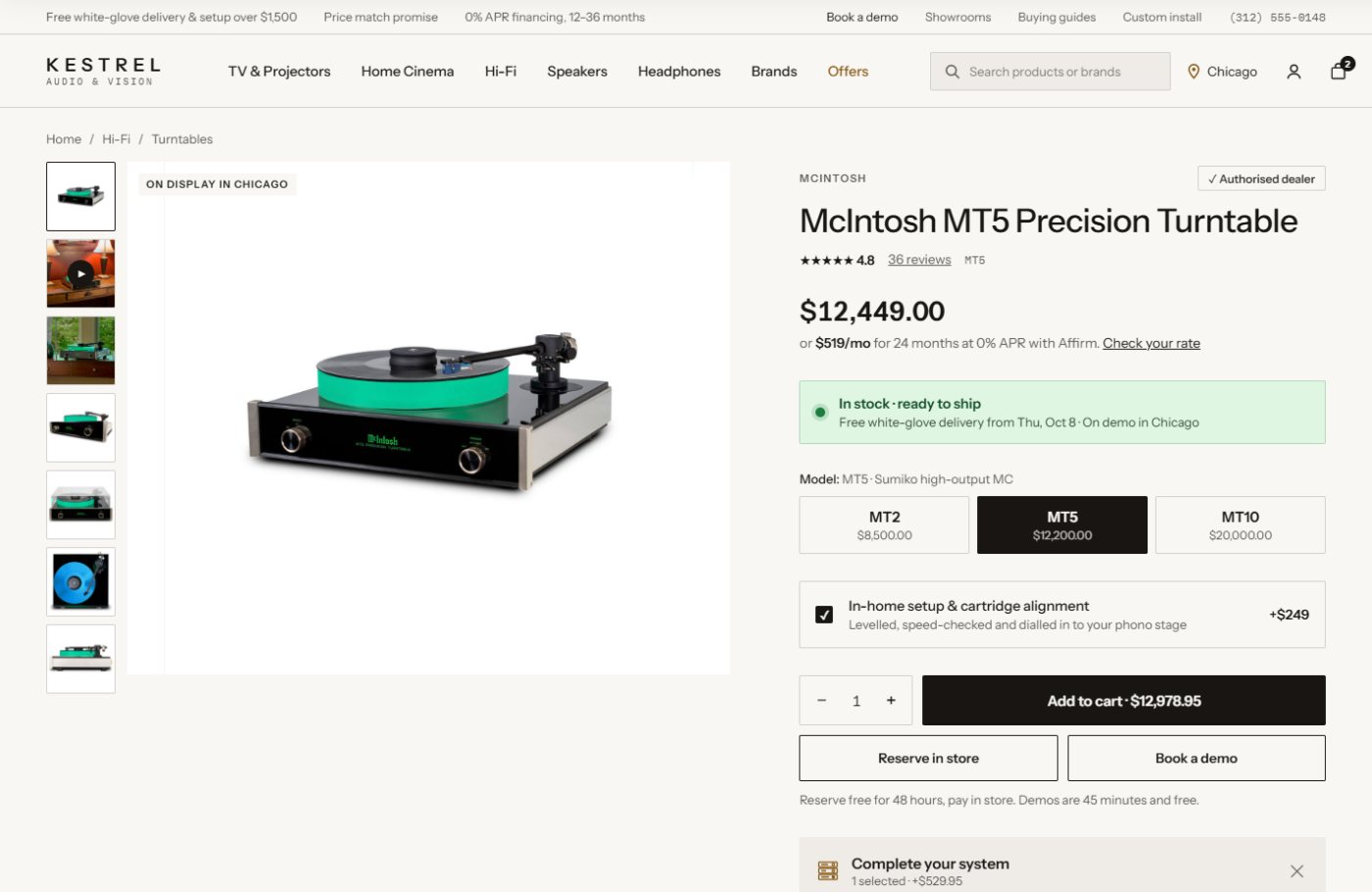
Everything on it answers a question a high-ticket AV buyer asks before they commit:
- Can I afford it monthly? Finance terms sit next to the price, not three clicks away.
- Can I hear it first? A clear marker shows the model is on display in the showroom, with a demo booking beside it.
- Is this a genuine dealer? An authorised-dealer badge answers the grey-market worry before it’s raised.
- Will it be set up properly? In-home setup and cartridge alignment are offered as options on the page.
- What else do I need? A “complete your system” builder suggests the phono stage, interconnects and power that make it work.
None of that is in a standard theme. Each one is a template decision, a data decision and a piece of development, and together they’re a large share of what you’re paying for. They’re also why a custom build tends to pay for itself on a store where the average order runs into thousands.
What’s included in the fee
Two quotes can show the same number and buy very different stores. These are included in both build routes, not sold later as a phase two.
- Speed. Targeting 1.5–2 seconds to load on mobile and desktop, INP under 200ms and CLS under 0.1, measured on real visitors.
- Technical SEO. Heading and internal-link architecture, canonical and pagination logic, and full structured data across product, collection, review, FAQ, breadcrumb and organisation.
- AI-search readiness. Machine-readable product, shipping and returns data, so assistants like ChatGPT and Google’s AI Mode can cite your store accurately.
- Native code. No page-builder apps, no monthly fee to keep your homepage rendering, no lock-in. You own everything built.
- Tracking. Analytics, conversion events and consent rebuilt and verified against live orders before launch.
- 30 days of fixes. Anything not behaving as scoped is corrected at no cost.
Why a cheap build costs an AV store more
Shopify’s own data across live stores puts the cost of every extra 100ms of load time at roughly 3.5% of conversion. On a store where the average order runs into thousands, that’s not a technical detail.
The bigger cost for AV is subtler. Under minimum advertised pricing, every authorised dealer shows the same price for the same model. Your website can’t win on price, so it has to win on trust, expertise and how the store feels. A template that looks like everyone else’s gives a customer no reason to buy from you rather than a national retailer. That’s the gap a custom build closes.
Redesign or rebuild?
The cheapest useful option isn’t always a new store. Before you budget a full build, it’s worth knowing which of the two jobs you actually need.
| Redesign | Rebuild | |
|---|---|---|
| What changes | The look and the conversion path on your existing Shopify store | The theme, templates, data structure and often the platform |
| Right when | Your catalogue, apps and order history are sound, and the problem is how the store presents and converts | The store is slow, can’t rank, sits on a platform no one can develop, or can’t carry the catalogue |
| Typical route | Custom theme build, from $9,997 | Custom theme or bespoke build, plus migration if you’re moving platform |
| Example | Hi-Fi Centre: a custom theme on its existing Shopify store, no migration | Lipton’s Audio & Video: a full migration to Shopify with a custom theme |
The audit tells you which one you’re looking at. If it’s a redesign, you’ll hear that before anyone quotes you for more.
What the investment returned for two AV retailers
Two Canadian AV retailers rebuilt on Shopify with KA Consultancy, then grew with senior-led marketing. These results cover the build and the marketing together over several years, not the build alone.
| Lipton’s Audio & Video, Ontario | Hi-Fi Centre, Vancouver | |
|---|---|---|
| Work | Shopify migration, custom theme design and development, SEO, Google and Meta ads | Custom theme design and development, technical SEO, paid media |
| Revenue | +191%, then +114% the following year | +202% (tripled in three years) |
| Return on ad spend | 11.9x blended | 19x blended, measured against real store revenue |
| Also | Marketing cost fell from 17.6% to 8.5% of revenue | Seven agencies had tried before the rebuild |
Read the Lipton’s Audio & Video Shopify case study and the Hi-Fi Centre Shopify case study for the full accounts, or see how we approach Shopify website design for hi-fi and AV retailers.
See what your store is losing, for free.
Book a free auditHow to compare two quotes
If you’re talking to more than one agency or freelancer, the headline number tells you very little on its own. Put each quote against the same questions:
- Is the scope written down, template by template? “Homepage, collection and product page” isn’t a scope. A list of every template and what each must do is.
- Is it a custom theme, or a purchased theme with changes? Both are legitimate, but they aren’t the same product and shouldn’t be priced as if they were.
- Are speed, technical SEO and structured data included, or quoted as a later phase?
- Who migrates the data and maps the redirects? If the answer is vague, that’s where the risk in the project sits.
- Who owns the code at the end? You should own everything built, with no licence fee to keep the store running.
- What happens after launch? A defined fix period, monitored against a baseline, is the minimum.
- Has the team built for specialist retail before? Ask to see a store with a deep, specification-heavy catalogue, not just a fashion brand.
A quote that answers all seven clearly is worth more than a cheaper one that answers three.
How a build runs
- Audit and scoping callCurrent speed, technical SEO, AI readability, the conversion path and the app stack. You get a fixed scope, fixed fee and launch date in writing before anything is committed. Free.
- Onboarding and specificationTemplate by template: what each page must do and what functionality it needs. The output is a written specification the whole build is measured against.
- Design, reviewed and signed offStructure first, then the visual system, worked through on real templates and real products, not a homepage mockup with placeholder copy.
- Build and instrumentNative theme code against the signed-off specification, with speed and technical SEO built in. Tracking verified against live orders before launch.
- Launch, then stayStaged launch, redirect mapping, monitoring against the pre-launch baseline, and 30 days of fixes included.
A year-one budget
Putting the three parts together, here’s the floor for an established AV store on the recommended route.
| Cost | Grow plan | Advanced plan |
|---|---|---|
| Custom theme design and build (one-off) | From $9,997 | From $9,997 |
| Shopify plan, paid annually | $948 | $3,588 |
| Payment processing (US online, Shopify Payments) | 2.7% + 30¢ per sale | 2.5% + 30¢ per sale |
| Apps | Depends on your stack | Depends on your stack |
| Year-one floor before apps and processing | From $10,945 | From $13,585 |
Apps vary too much by store to put one number on. A native-code build usually needs fewer of them, because functionality is built into the theme instead of bolted on.
Marketing isn’t in this table. It’s priced separately, and you don’t have to take it: plenty of build clients keep their existing agency or in-house team. If it’s useful, our Shopify marketing consultant page covers that side.
What it costs to run after launch
The build is a one-off. These are the costs that carry on, and the ones worth planning for in year two.
Shopify plan and payments
Your plan renews monthly or annually, and processing is charged on every sale. On a high-ticket catalogue, processing will usually be a bigger line than the plan itself, which is why the plan choice above matters.
Apps
Reviews, email, search, finance, shipping and loyalty apps each carry a monthly fee. A custom theme reduces how many you need, because features like filtering, bundles, comparison and showroom stock can be built into the theme rather than rented from an app. Review the app list once a year; most stores carry at least one they no longer use.
Theme upkeep
A native-code theme you own doesn’t need a page-builder subscription to keep rendering, and Shopify platform updates don’t overwrite it the way they can overwrite a heavily modified store theme. You’ll still want small changes over time: new templates for a new brand, seasonal campaign pages, a new integration. Those are scoped as and when you need them.
Content and product data
New models arrive every season. Someone has to write descriptions that go beyond manufacturer copy, keep specifications structured and add the right images. Budget time for it, in-house or outsourced, because a strong store with stale product pages slowly stops ranking.
Marketing
A new store doesn’t bring its own traffic. Most AV retailers run Google Shopping, Google Ads and Meta alongside SEO. If you want us to run it, marketing retainers start from $2,997 a month and are priced separately from the build. Plenty of build clients keep their existing team instead.
When a custom build isn’t right for you
A custom build is the right spend for an established AV retailer whose website is holding back a strong business. It isn’t right for everyone, and it’s better to know before you spend.
You need to be live in two weeks. A launch date that doesn’t allow for structure, design and engineering to be done properly will produce exactly the store you’re trying to replace.
The budget is most of your available capital. If a $9,997 build would take most of what you have, prove the product first on a theme-store theme.
You’re hoping design will fix a product problem. A redesign won’t repair pricing, margin or a range customers don’t want, and you’ll be told so on the first call.
You’re shopping for the cheapest quote. There’s always someone cheaper. The question is what the store does for your revenue in the three years after launch.
Your current store is sound. If the catalogue, apps and order history are fine and the problem is the conversion path, a redesign may be enough, and it costs less than a rebuild.
Shopify website cost for AV retailers: FAQ
Sources
Shopify plan prices, annual totals and US card rates: Stack Influence, July 2026, Swell, April 2026 and Ecommerce Platforms. Shopify changes its plans from time to time, so check shopify.com/pricing before you budget.
KA Consultancy prices, inclusions, timelines and process are as published on our Shopify website design page. Case study results are from the Lipton’s and Hi-Fi Centre case studies.